Mastering Fibonacci Extension Levels in Forex Trading (Complete Guide)
Have you ever stood in front of a price chart wondering why the price would appear to hit pause, or worse, reverse at a certain level? The action may have appeared random, and all of a sudden, the market hits a wall, an invisible wall or finds support exactly where you least expected it to. There is no magic in price action. More often than not, Fibonacci extension, or extension, is to blame.
Fibonacci extension is one of the most powerful and yet least used tools in technical analysis. Many traders are concerned with retracement levels in finding entry levels. Extensions can give you a little bit of help predicting where trends may actually end. Think of it as your crystal ball for price targets - but instead of divining what will happen next based on vague hunches, you are relying on an exact number pinpointed by mathematics.
We at Tradewill.com have seen countless traders change their approach to trading when they finally get a handle on this tool. Whether you are a pro simply looking for a way to support picking your targets or a beginner trying to understand why certain levels are significant, this is your guide to learning everything you need to know about Fibonacci extensions in forex trading.
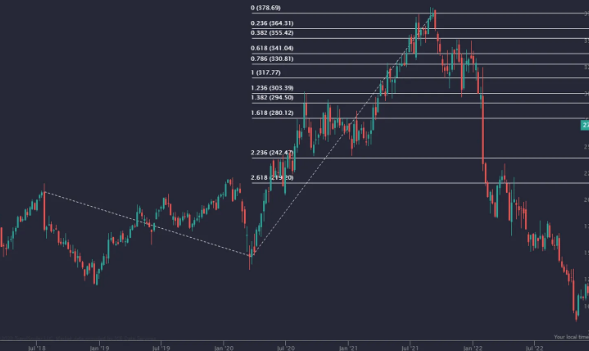
Fibonacci extensions are beautiful because they can be used universally. From the EUR/USD finding the perfect 161.8% for a take-profit to crypto traders using these ratios in greater volatility, you can see how they are always at play. However, extensions are like any other powerful tool. They need to be understood and used correctly to be used effectively.
What is Fibonacci Extension?
Fibonacci extension is a technical analysis tool used to estimate price targets beyond the actual trend, using the ratios of the Fibonacci sequence. As you can see, while retracements indicate potential reversal points within a range, extensions estimate where the trend (up or down) may ultimately wind up.
The ratios you will be dealing with are 61.8%, 100%, 161.8% and 261.8%. These are all calculated numbers based on the Fibonacci sequence; however, they represent levels at which the price may experience significant price support or resistance. The 161.8% extension has especially received mythical status among traders, as the 'golden extension'.
To draw Fibonacci Extensions, you need three things: a swing low, a swing high, and a retracement low (in an uptrend). Once the tool has the values, it shows where the mathematical relationship will project, where the next wave might end. Think of it as a map of where you are and where you are going or likely going as you follow the path.
As a reference, suppose EUR/USD climbed from 1.0500 to 1.0800 and retraced to 1.0650. If you then drew a Fibonacci extension from 1.0500 to 1.0800 to 1.0650, the extension may show a projected target at 1.0850 (61.8% extension), 1.0950 (100% extension), 1.1130 (161.8% extension), etc. You would then have your possible take profit zones.
The reason the extensions work is that thousands of traders around the world are also seeing those levels. When price approaches a major extension level, it triggers a self-fulfilling prophecy as traders close their positions (take profits) or open new ones based on the anticipated reaction.
To contextualise this, think about estimating the height of a folded paper aeroplane when you throw it. The height will be determined by physics, gravity, centre of gravity, kinetic energy (when thrown), and its flight path. In the market, the same could be said for price movement as influenced by psychological factors and its mathematical relationship to create patterns over time. Extensions give you the formula to estimate the invisible target zones.
Extensions perform best when there is a strong and clear market trend. They lose most of their predictive value in a choppy, sideways market. Extensions are a valuable tool when there is a trend move happening that is sustained and price has already established a directional bias.
Famous Fibonacci Sequence
The Fibonacci sequence has origins from mathematician Leonardo Fibonacci, who lived in Italy during the 1300s, although the mathematical relationships appear in nature (e.g., the petals of a flower, the spirals of a galaxy). The sequence has developed a famous golden ratio (1.618) that provides proportions that the human psyche desires and considers significant.
So, why do financial markets pay tribute to Fibonacci ratios? The answers lie in collective human behaviour and market psychology. All over the world, thousands of traders use Fibonacci tools, leading to zones of concentrated buying or selling. When enough participants act at similar mathematical levels, they become real support or resistance zones.
There is naturally a wave-like movement in the market where price moves up, then down, back and forth, but ultimately, there becomes a price where each wave begins and ends. Just as ocean waves have a mathematical relationship between the crest and trough, it is the same with the price waves and is often identified by the Fibonacci proportions. This is not mystical; it is crowd psychology or behaviour working itself out in patterns we can recognise.
For more info :-


Comments
Post a Comment