Why Diversify When the S&P 500 Performs So Well?
Introduction
A highly rated comment on Reddit’s r/investing neatly summarizes the modern investor’s dilemma: “The S&P 500 feels perfect, but you’re betting on one country and a few companies.” This observation cuts to the core of the investment environment we are in now: the S&P 500’s great performance has made many ask the question: why bother with diversification?
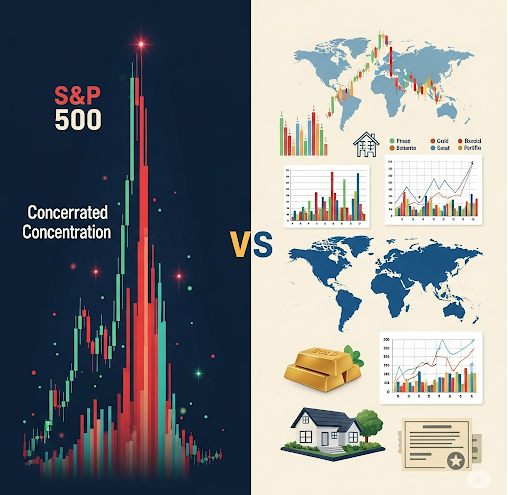
The numbers are clear about the S&P 500 and its domination. The index has returned around 13% a year over the last ten years, making it the kingpin of hundreds of portfolios across the world. After all, the S&P 500, as we mentioned above, has issued gains of more than 20% in back-to-back years, and it’s natural to wonder: why mess around with diversification if the index is treating us so nicely?
But beneath this apparent rosy picture lurks a rather more complicated one. Heading into early 2025, the top 10 companies in the S.&P. 500 were accounting for nearly 40 percent of the index — a concentration that was even higher than at the peak of the dot-com bubble. This concentration, while producing impressive returns can also present risks that a lot of investors may not fully grasp.
This is not an article to bash the S&P 500 – the S&P 500 is a great investment vehicle. Not put another way but rather as a better way of looking at it, let’s consider why — no matter how awesome the record of that single basket — it might not be the smartest long-term play to put all of your eggs into it. We’ll look at what S&P 500 can and cannot do, take a closer look at the diversification shown to us by basic principles, and offer some real-world advice on how you might build a portfolio that can withstand the turbulent waters so characteristic of today’s markets.
And remember, the point isn’t to throw out what works, but to know when and how to supplement it for superior long-term results.
Why They Love the S&P
The S.&P. 500 is popular for good reason — it consists of the 500 biggest publicly traded companies in the United States, weighted for market size. With this straightforward format, it has become the world’s most followed stock market index and the bedrock of passive investing.
Three reasons to be a S&P 500 Bull
-
Consistent Long-Term Returns: The proof of the S&P 500’s run is in the numbers. Through the last 100 years, the index has seen an average annual return of about 10%, making it a good candidate for long-term wealth creation. This is why it has been the standard advice for retirement accounts, college savings and other long-term investment goals.
-
Simplicity and cheap access: Index funds and ETFs such as SPY, VOO and IVV have made S&P 500 investing available to the masses. Expenses are as low as 0.03% and you get exposure to 500 companies with one purchase. It also strips away the requirement to choose stocks or time the market or to pay steep fees to active fund managers.
-
Tech Giant Dominance is Driving: The Performance Since the index is market-cap weighted, therefore, companies such as Apple, Microsoft, NVIDIA, and Amazon all hold sway over performance. Shares of tech giants Nvidia and Apple surged by 171% and 33% in 2024, respectively, helping lift the information technology sector. This tilt toward high-growth tech firms has been instrumental in spurring the index’s outperformance.
The "Lazy Investor's" Perfect Choice
Reddit users commonly call the S&P 500 the “lazy investor’s pick” and it’s intended as a compliment. No stock picking, no sector timing, no actively managed decisions. It’s a simple fact that the vast majority of actively managed funds do not outperform the S&P 500 over long time frames, suggesting that an intellectually sound way to invest is to passively index.
Performance Comparison Evidence:
-
More than 90% of large-cap funds exhibit shmutz over 15-year periods.
-
Active funds’ average expense ratio (0.68%) is over 20 times that of top S&P 500 index funds
-
In the entire 2024 year, just 19% of stocks in the S&P 500 did better than the index
The S&P 500 is in fact a great core portfolio asset — something this article doesn’t argue against. But referring to it as a “magic solution” misses out on some key subtleties that arise when we ask what diversification is, and why it’s important for the preservation of wealth over the long term.
Why Diversify Your Portfolio?
Diversifying assets is widely considered one of the few “free lunches” in investing that allows the reduction of a portfolio’s risk without explicit trade-offs in returns. At a fundamental level, diversification refers to the practice of spreading investments among various asset classes, geographical regions, and business sectors, all with the aim of insulating oneself from the poor performance of any one investment.
The Modern Portfolio Theory
Modern Portfolio Theory, pioneered by Nobel laureate Harry Markowitz, illustrates that by blending assets that possess noncorrelated risk/return profiles, you may develop portfolios that are more efficient than individual assets on their own. The big idea: Investors can earn a better risk-adjusted return by owning uncorrelated assets than by investing in one asset, no matter how appealing it might seem.
Reddit Users Comments on S&P 500 Restrictions
The investment world has pinpointed at least three major issues with S&P 500 concentration:
Geographic Concentration Risk:
-
“The S&P 500 isn’t the global market, ain’t nothing but a reflection of the US market.”
-
“Investing in the S&P 500 is a bet that America will not fail.”
-
Company Concentration Risk:
-
“You think you’re buying 500 companies, and you’ve got these wonderful five companies and the other 495 are not contributing, but you don’t know what the five are that are going to work better than the others in the future.”
These observations underscore that S&P 500 investing, while diversified within the U.S. market, is a concentrated bet on American economic dominance and a handful of mega-cap technology companies.
Historical Evidence: When does Diversification work Best?
The 2000 Tech Bubble Case Study: From 2000-2002 (the dot-com crash), the S&P 500 fell about 49% while:
-
Gold gained 12% annually
-
Treasury bonds returned 8-10% annually
-
Foreign developed markets fell modestly less If you have any questions on this post, please feel free to leave a comment below.
-
REITs have been the winners
The 2022 Market Correction: When the S&P 500 fell 18% in 2022:
-
The best-performing energy sector ETFs were up more than 60%
-
Commodity funds provided positive returns
-
International value beat U.S. growth
Understanding Risk-Adjusted Returns
The central benefit of diversification isn’t that it necessarily delivers higher returns — it’s better returns relative to the risk you take, as measured by the Sharpe ratio (returns per unit of risk). A diversified portfolio won’t fare as well as the S&P 500 in good times, but it also offers vital protection in the down times.
Key Benefits of Diversification:
-
Lessened Portfolio Volatility: Doing away with the extremes highs and lows
-
Decrease Max Drawdown: Lessening the maximum potential loss that could occur when all trades are closed.
-
Better Sleep Fact: Have less worries during market volatility
-
Capture Opportunity: Riding the outperformance wave of various assets
Diversification won’t make you rich and it won’t prevent you from going broke, but it can make the experience of investing much more palatable by lessening the psychological toll of watching a concentrated portfolio get ravaged during market downturns. Or, as a wisecracks one on Reddit put it: “Diversification is insurance, not a performance enhancing drug.
The Downside to the S&P 500
The S&P 500’s record speaks for itself, and yet a look under the hood shows structural biases and blind spots that investors need to understand, especially before focusing their portfolios around this single index.
The Concentration Reality
Reddit’s Fundamental Insight: “Five Companies, Not 500.” Early in 2025, the top 10 companies in the S&P 500 constituted nearly 40% of the index — even higher than the peak levels of the dot-com bubble. This concentration is the reason that, despite owning shares in 500 companies, the performance of your portfolio is disproportionately affected by a few mega-cap stocks.
Top 10 S&P 500 Holdings (Approximates as of 2025):
-
Apple (7.0%)
-
Microsoft (6.8%)
-
NVIDIA (5.2%)
-
Amazon (3.8%)
-
Alphabet (Class A & C combined): (3.5%)
-
Meta (2.8%)
-
Tesla (2.3%)
-
Berkshire Hathaway (1.8%)
-
Broadcom (1.7%)
-
JPMorgan Chase (1.6%)
These 10 businesses make up more than 36% of the index, such that roughly one-third of your S&P 500 investment is really a bet on these 10 companies.
For more info :-


Comments
Post a Comment