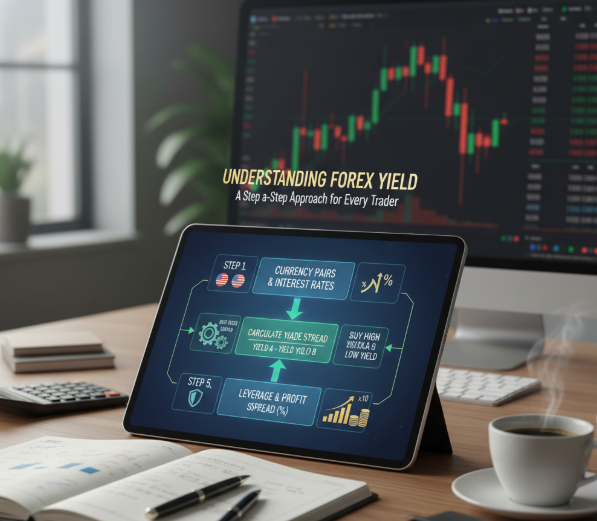
Understanding Forex Yield: A Step-by-Step Approach for Every Trader
The yield is what you receive for holding a currency or investment over time. Yield in the forex market is the difference in interest rates between two currencies that allows traders to profit from the difference. The easiest way to look at it is like "rent" for lending your money at any given moment to a country by holding its currency.
In this situation, yield becomes magical when there's a big difference between what two countries pay to borrow money. If the US Federal Reserve sets interest rates to 5%, while Japan is near 0%, that 5% difference is a goldmine for a trader knowing what to look for! This is called a carry trade - you borrow the lower-yielding currency (Japanese yen) and buy the higher-yielding currency (the US dollar), keeping the difference for yourself!
What Are the Types and How to Calculate Them
Now let's break yield down into manageable and digestible bites. Picture yield types like different types to gauge how fast your car is going, you might look at miles per hour, kilometres per hour, feet per second; they all give you the same fundamental information, from different angles.
Effective Yield accounts for compounding and fees to calculate what you actually earn. Going back to the car analogy, effective yield would be your actual mileage based on road conditions and traffic. If you are getting 4%, but you are paying 0.5% in transaction costs, that'd make your effective yield 3.5%.
History and Market Context of Yield
In the 1980s, when rates in developed countries were regularly above double digits, yield hunting was a very different story. The US had rates above 10%, and dollar investments were exceptionally attractive to investors looking to hunt yields. Now, 5% is considered really high. The world has changed since then.
These shifts come from changes in central bank policy. When the US Federal Reserve adjusts the federal funds rate up or down, it sends shockwaves through every currency pair that uses the dollar. The financial crisis of 2008-2009 is a great example. As central banks moved to cut rates and set them close to zero to stimulate their economies, all traditional carry-trade transactions collapsed overnight.
Yield vs Other Asset Classes: Comparing Returns Across Markets
Forex yield doesn't exist in a vacuum. To fully evaluate the value of forex yield, it is important to understand how it compares to other investments. It is similar to choosing between transportation options, where each has advantages depending on your destination.
Forex yield has some unique advantages, like liquidity, a 24-hour market, and leverage. Whereas otherwise an investor expects an annual dividend of 2-3% on common stocks, a forex carry trade could earn an investor 3-7% from merely interest rate differentials, not even counting any favourable movement in currency. The downside? Currency risk can become disadvantageous just as strongly.
How Yield Interacts with Monetary Policy
Central banks are the great controllers of the forex yield. They can change yield calculations around the world just by issuing a statement, saying, or hinting at something. Understanding this relationship is like learning the rules of the game before getting in the game.
When the FOMC raises interest rates, the USD yield instantly becomes more valuable. This cause and effect has not gone anywhere; it is just like the supply and demand of the whole, the higher the rate of interest, the higher return of holding a dollar. So, if the higher return on investing dollars, the higher demand will be for dollars. Of course, this was absolutely true between 2022 and 2023 when the Federal Reserve became very aggressive in raising rates in order to combat inflation, and it made dollar-based investments very attractive after years of pushing the rate down to almost zero.
Conclusion and Key Takeaways
Once an individual understands how to incorporate yield into the forex market, an entire world of trading opportunities opens up that many beginners will never discover for themselves. Beyond simply generating interest on invested capital, this is a powerful way of utilising the fundamentals that drive the value of money, in conjunction with the economics of interest rates, to find ways to profit from the differential.
Yield has both an opportunity and a risk factor. In general, the higher the yield, the greater the chance that the country is undergoing economic challenges, while lower yields are often what more stable and developed countries will pay. Your role as a trader is to identify the right size of opportunity and the greatest level of risk management.
For more info:-
.png)

Comments
Post a Comment